Stainless Steel and Duplex Forged Flanges

Stainless and duplex flanges are specified for what the steel resists rather than for what it carries. The austenitic A182 grades cover general corrosion service; duplex and super duplex add chloride stress-corrosion resistance, which is why offshore, desalination and chemical work calls for them.

  • ASTM A182 F304/F304L · F316/F316L · F321 · F347 · duplex F51
  • MTC 3.1 per heat · 304L/316L sample on this page
  • Duplex records kept per heat and per batch
  • Carbon footprint verified to ISO 14067:2018

Stainless Steel Forged Flanges Explained

Grades supplied are ASTM A182 F304 and F304L, F316 and F316L, F321 and F347, duplex F51, and super duplex grades confirmed by project review. The flange type and dimensions still come from ASME, EN, DIN, GOST or your drawing - the grade decision changes the certificate route, not the table.

For F304/F316 RFQs, define the PMI scope when the purchase specification requires it. For duplex or super duplex, request a grade-specific MTC plus PMI; add ferrite, corrosion, UT, MT, PT or third-party inspection only when the project specification names them. State passivation or any special surface finish rather than assuming it is included.

Engineering Snapshot

Product family: Flanges

Stainless Steel Forged Flanges Supply Scope

Stainless and duplex flange RFQs are reviewed by material grade, corrosion service, standard, pressure rating, heat treatment, PMI, inspection and document needs.

  • ASTM A182 F304 / F304L, F316 / F316L and project-specified stainless grades
  • Duplex and super duplex forged flange requirements by project
  • PMI, MTC 3.1, dimensional and NDT requirements checked before quotation
Austenitic stainless: one grade, six designation systems

The nearest designation of each grade in the US, European, Japanese, Korean, Chinese and Russian systems, for reading a line list written in any of them. These are nearest designations, not equivalences: the purchase specification governs, and substituting one for another needs the purchaser's written approval.

Austenitic stainless forging grades across ASTM A182, EN 10222-5, JIS G 3214, KS D 4115, NB/T 47010 and GOST 5632
Common nameUS: ASTM A182 (UNS)EU: EN 10222-5 (no.)JIS G 3214KS D 4115China: NB/T 47010 (GB/T 20878)GOST 5632 (nearest)Differences to state
304F304 (S30400)X5CrNi18-10
1.4301
SUSF304STS F304S30408 (06Cr19Ni10)08Х18Н1008Х18Н10 allows Cr 17-19 % against 18-20 % for F304
304LF304L (S30403)X2CrNi18-9
1.4307
SUSF304LS30403 (022Cr19Ni10)03Х18Н11Dual 304/304L certification is common but must be asked for, not assumed
316F316 (S31600)X5CrNiMo17-12-2
1.4401
SUSF316STS F316S31608 (06Cr17Ni12Mo2)Compare the molybdenum windows of the two specifications before accepting one against the other
316LF316L (S31603)X2CrNiMo17-12-2
1.4404
SUSF316LS31603 (022Cr17Ni12Mo2)03Х17Н14М3The GOST mark reads about 14 % Ni and 3 % Mo - richer than 316L; not interchangeable without review
316TiF316Ti (S31635)——10Х17Н13М2ТTitanium-stabilised 316: order it by name, it is not 316L
321F321 (S32100)X6CrNiTi18-10
1.4541
SUSF321S32168 (06Cr18Ni11Ti)08Х18Н10Т (nearest)
12Х18Н10Т
12Х18Н10Т allows C up to 0.12 % against 0.08 % max for F321 (GOST 5632), so it is not automatically F321
347 / 347HF347 (S34700)
F347H (S34709)
SUSF347
SUSF347H
S34778 (06Cr18Ni11Nb)08Х18Н12Б347H has a carbon minimum for creep strength; our Annex I lists F347, not F347H

A dash means no designation was found in that system; a blank cell means we have not yet checked that system's current edition, so we list nothing rather than guess. Every row and every designation has its own anchor, e.g. #s30408, #1-4404 or #12x18n10t.

Duplex and super duplex designations

The name 2205 covers two UNS windows, and super duplex splits into two grades that are not interchangeable. Reading the exact designation on your line list tells you which certificate and tests apply.

Duplex and super duplex designations across ASTM A182, EN, JIS, KS, NB/T 47010 and GOST
Common nameUS: ASTM A182 (UNS)EU (no.)JISKSChina: NB/T 47010 (GB/T 20878)GOSTDifferences to state
2205, wider windowF51 (S31803)X2CrNiMoN22-5-3
1.4462
SUS329J3L - bar and plate only; JIS G 3214 has no duplex forging gradeS22253 (022Cr22Ni5Mo3N)S31803 window: Cr 21.0-23.0, Mo 2.5-3.5, N 0.08-0.20 %
2205, tighter windowF60 (S32205)1.4462as aboveS22053 (022Cr23Ni5Mo3N)—S32205 window: Cr 22.0-23.0, Mo 3.0-3.5, N 0.14-0.20 % - the windows printed on our S22053 type-test report
2507 super duplexF53 (S32750)S25073 (022Cr25Ni7Mo4N)—Cr 24-26, Mo 3-5, N 0.24-0.32 %
Super duplex with Cu and WF55 (S32760)X2CrNiMoCuWN25-7-4
1.4501
——S27603 (022Cr25Ni7Mo4WCuN)—Adds Cu 0.50-1.00 and W 0.50-1.00 %; not interchangeable with F53 without approval

Same conventions as the table above. JIS G 3214 has no duplex forging grade (SUS329J3L is a bar and plate designation), so a duplex forging bought against a JIS line list is ordered by an ASTM, EN or project grade.

Why our S22053 is read as S32205 / F60, not just 2205

Our duplex type test was run on S22053, the Chinese designation (022Cr23Ni5Mo3N) in NB/T 47010. The report prints the windows the sample was held to: chromium 22.00-23.00 %, nickel 4.50-6.50 %, molybdenum 3.00-3.50 % and nitrogen 0.14-0.20 %. Those are the S32205 windows of A182 F60, so S22053 is nearest to F60, not merely to 2205 in general.

A heat inside the S32205 window also sits inside the wider S31803 window of F51, which is why F51/F60 dual certification is common. The chemistry overlap does not make the certificates interchangeable: the mechanical and test requirements are still checked against each grade the certificate names.

Nitrogen on our sample came in at 0.14 %, the lowest value the window allows. If your line class relies on nitrogen for pitting resistance, put a minimum or a PREN requirement on the RFQ so it is checked per heat.

Four designation traps to settle before quotation

Each of these can turn a stainless line item into a re-quote. The standard does not settle them - the RFQ has to.

  • Reading 12Х18Н10Т as F321: the carbon limits differ (0.12 % against 0.08 %), and 08Х18Н10Т is the closer mark.
  • Assuming 304/304L or 316/316L dual certification: it is common but it is a certificate requirement, so it has to be written on the order.
  • Treating F53 and F55 as the same super duplex: F55 adds copper and tungsten, and substitution needs the purchaser's approval.
  • Looking for a JIS G 3214 duplex forging grade: there is none; SUS329J3L is a bar and plate designation.

Duplex in our class-society approvals and certified material scope

Each approval prints its own duplex line and limits; the table keeps every figure on its own document. An approval covers our manufacturing process - each classed order is still certified by that society's surveyor where its rules require.

Duplex stainless in our class-society approvals, as printed on each document
SocietyDocumentDuplex as printedLimit printed for duplexForging method printed
ABSFOR-0055952Duplex stainless (work-order attachment)500 kgFree forge; die forge
Bureau VeritasSMS.W.II./152398/A.0Duplex stainless steel forging500 kgNot printed
DNVAMMM000038822 Cr duplex; 25 Cr duplex600 kg, 150 mm, solution heat treatedClosed and open die
Lloyd's RegisterLR25409452WADuplex stainless steel500 kgOpen die (free)
Korean RegisterDLN51990-SF00122Cr duplex; 25Cr duplex stainless steel3,000 kg - one limit for the whole approvalOpen die
ClassNKST628CF (TA2677E)Duplex Stainless Steels (ASTM A182/A182M)None printedForging / heat treatment, method not printed

The six documents in full, with every material family and limit, are compared on the marine and shipbuilding page.

F51, F53, F55 and F60 are also listed in Annex I of our materials certification to ASME Section II Part A by TÜV NORD. That is a certified material scope, not a record of shipments: super duplex F53 and F55 are quoted after review of the exact grade, sizes and tests.

Duplex flanges in production quantities: what stays the same from heat to heat

For a duplex or super duplex order that runs across several heats and heat-treatment batches, consistency comes from records kept per heat and per batch, and from tests whose frequency the order fixes before production starts. Our forging output across all grades is about 3,000 tonnes a month.

Records and tests for a duplex order, and what the order should state
ItemWhat we doWhat the order should state
MTC 3.1Issued per heat number.The certificate type and any project-specific fields.
Solution annealing recordKept for every heat-treatment furnace load or batch: the heat or batch link, temperature, soaking time, cooling method and the temperature chart.Whether the heat-treatment report or chart should travel with the certificates; we supply it on request.
PMIScope set per order: every piece, or sampling.Every piece, or a sampling plan with the sampling ratio, lot definition and acceptance rule. Testing every piece gives stronger traceability and protection against mixed material, at a higher cost.
Ferrite contentA focus for duplex and super duplex. Test frequency, sampling and acceptance range follow the material standard and the project specification.The frequency you need, for example per heat or per heat-treatment batch; we then test at that frequency.
Corrosion test (e.g. ASTM G48)Done when the purchase order or project specification asks for it. A standard MTC 3.1 does not come with a G48 report.Test method, temperature, duration, sampling frequency and acceptance criteria.

Product carbon footprint of our stainless steel forgings

China Quality Mark Certification Group (CQM) verified the cradle-to-gate carbon footprint of our stainless steel forgings to ISO 14067:2018, using 2024 data. Statement CQM25CFPX700075R0 was first issued on 10 November 2025 and is valid to 9 November 2027.

Cradle-to-gate carbon footprint per tonne of stainless steel forgings, 2024 data
Stagekg CO2e per tonneShare
Raw material acquisition and pre-processing9,365.9994.6 %
Raw material transport183.221.85 %
Manufacturing351.23.55 %
Total, cradle to gate9,900.41100 %

Statement CQM25CFPX700075R0 (PDF)

Stainless Steel Forged Flanges Technical Specification

Stainless Steel Forged Flanges Technical Specification
Scope and rating
Grade scopeASTM A182 F304/F304L, F316/F316L, F316Ti, F321, F347, duplex F51/F60; super duplex F53/F55 are in our certified material scope and quoted after project review.
Standards and materials
Standards / drawings
  • Project drawing or purchase specification
  • ASME B16.5 where flange dimensions follow ASME classes
  • EN 1092-1 / DIN where PN and DN requirements are specified
  • GOST 33259, 12820 or 12821 where CIS project requirements apply
  • ASTM, EN or project material standards as listed in the RFQ
Material grades
  • ASTM A105 carbon steel
  • ASTM A350 LF2 low-temperature carbon steel
  • Stainless steel grades such as 304, 316, 321 or 347
  • Duplex and super duplex grades when specified by the project
  • Alloy steel or drawing-specified grades subject to feasibility review
Geometry, tolerance and inspection
Shape scopeASME/EN/DIN/GOST or drawing controls the flange type; stainless/duplex controls PMI, corrosion-service notes and certificate route.
Critical dimensionsFacing, bore, bolt pattern, wall schedule, surface condition and passivation or special finish when specified.
Document focusMTC 3.1, PMI, heat number traceability, ferrite or NACE notes when specified, and dimensional report.
Inspection depthPMI is normally central; UT/MT/PT, surface condition and third-party inspection are added by project requirement.
Reviewed before quotation
  • Size, DN or NPS
  • Pressure class or PN rating
  • Drawing revision and critical dimensions
  • Facing, bore, bolt pattern and machining tolerance
  • Quantity, destination country and packing requirement
Buying logic
Best-fit RFQBest for ASTM A182 stainless, duplex and project-specified corrosion-resistant forged flange RFQs.
Buyer applicationChemical, offshore, desalination, food-adjacent utilities, petrochemical and corrosive service systems.
Download this table as PDF Request a quote

Your standard, drawing revision and project specification govern.

What the Records Show: Duplex S22053 and a 304L/316L MTC 3.1

What has an outside body measured on a duplex flange we forged?

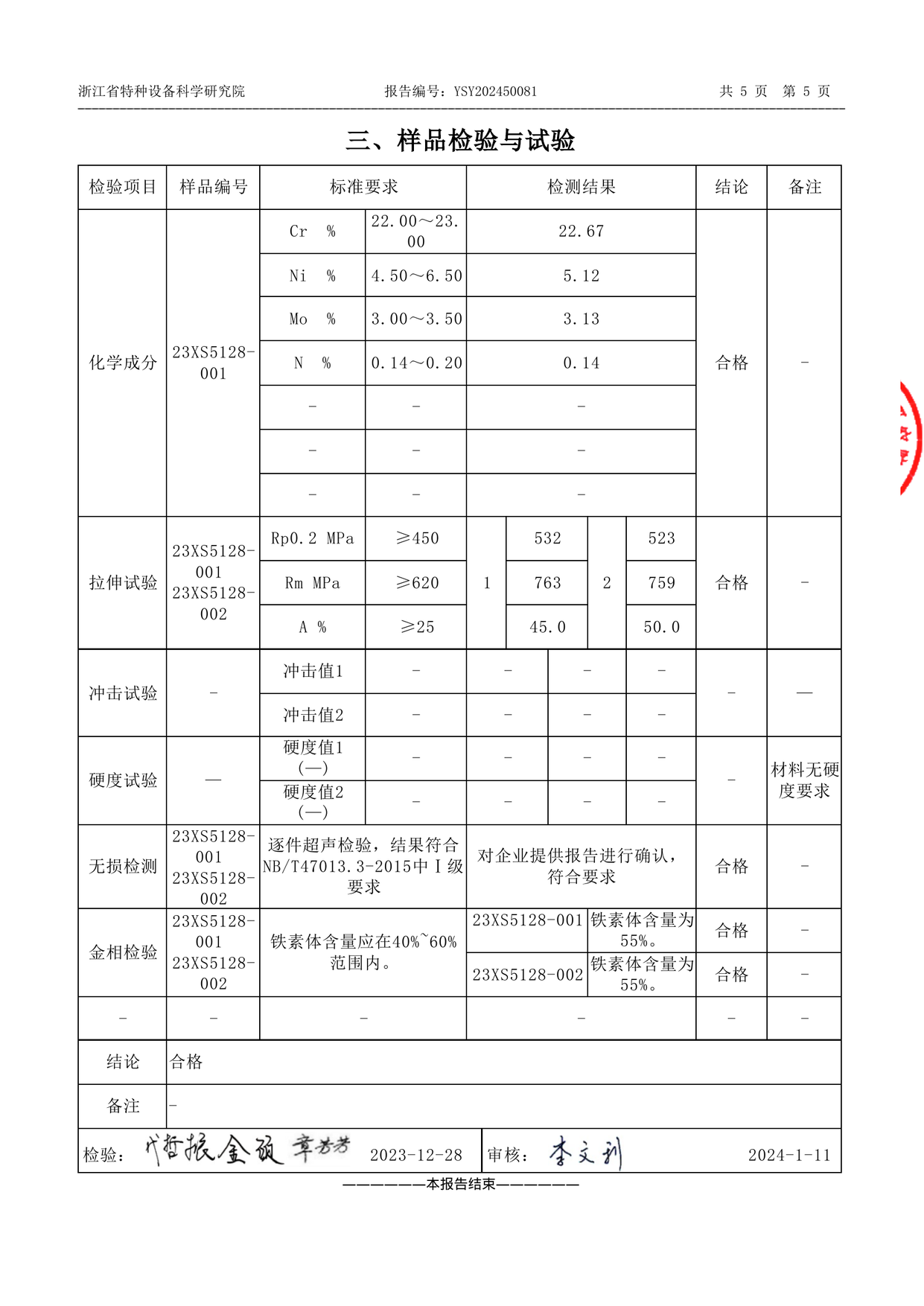
On one type-test sample set in S22053, report YSY202450081 records 55 % ferrite on both specimens against a 40-60 % window, chemistry inside the S32205-matching windows printed on the report, and tensile clear of the minima. The ferrite value belongs to S22053 only.

Evidence

  • Report YSY202450081, section III, page 5 of 5, metallographic row: specimens 23XS5128-001 and 23XS5128-002 each read 55 % ferrite; requirement 40-60 %
  • Same page, chemistry on specimen 23XS5128-001: Cr 22.67 % (22.00-23.00), Ni 5.12 % (4.50-6.50), Mo 3.13 % (3.00-3.50), N 0.14 % (0.14-0.20)
  • Same page, tensile row: Rp0.2 532 and 523 MPa against a 450 MPa minimum, Rm 763 and 759 MPa against 620 MPa, elongation A 45.0 % and 50.0 % against 25 %
  • Same page: the impact row holds only dashes, and the hardness row reads that the material has no hardness requirement
  • Issued by the Zhejiang Academy of Special Equipment Science; testing signed 2023-12-28, review signed 2024-01-11

Applies when

The sample was a DN80 (NPS 3) Class 150 raised-face weld neck flange in S22053 from our own production, tested as part of a special-equipment type test; two pieces were tested.

Limits

One sample set of one grade: the ferrite, chemistry and tensile values are not typical or guaranteed values, and they say nothing about F51, F53, F55 or any austenitic grade. The report holds no impact value and no corrosion test. Your order's ferrite, PREN or corrosion-test requirement is tested on your heat and reported on its own certificate.

Page 5 of 5 of type-test report YSY202450081: chromium, nickel, molybdenum and nitrogen results, tensile results for two specimens, empty impact and hardness rows, and a metallographic ferrite reading of 55 percent on each specimen for our S22053 duplex weld neck flange
Report YSY202450081, page 5 of 5: the S22053 data page

Sources

Every value above was checked against the linked documents on 2026-09-26.

What does an EN 10204 3.1 certificate for our stainless forged flanges show?

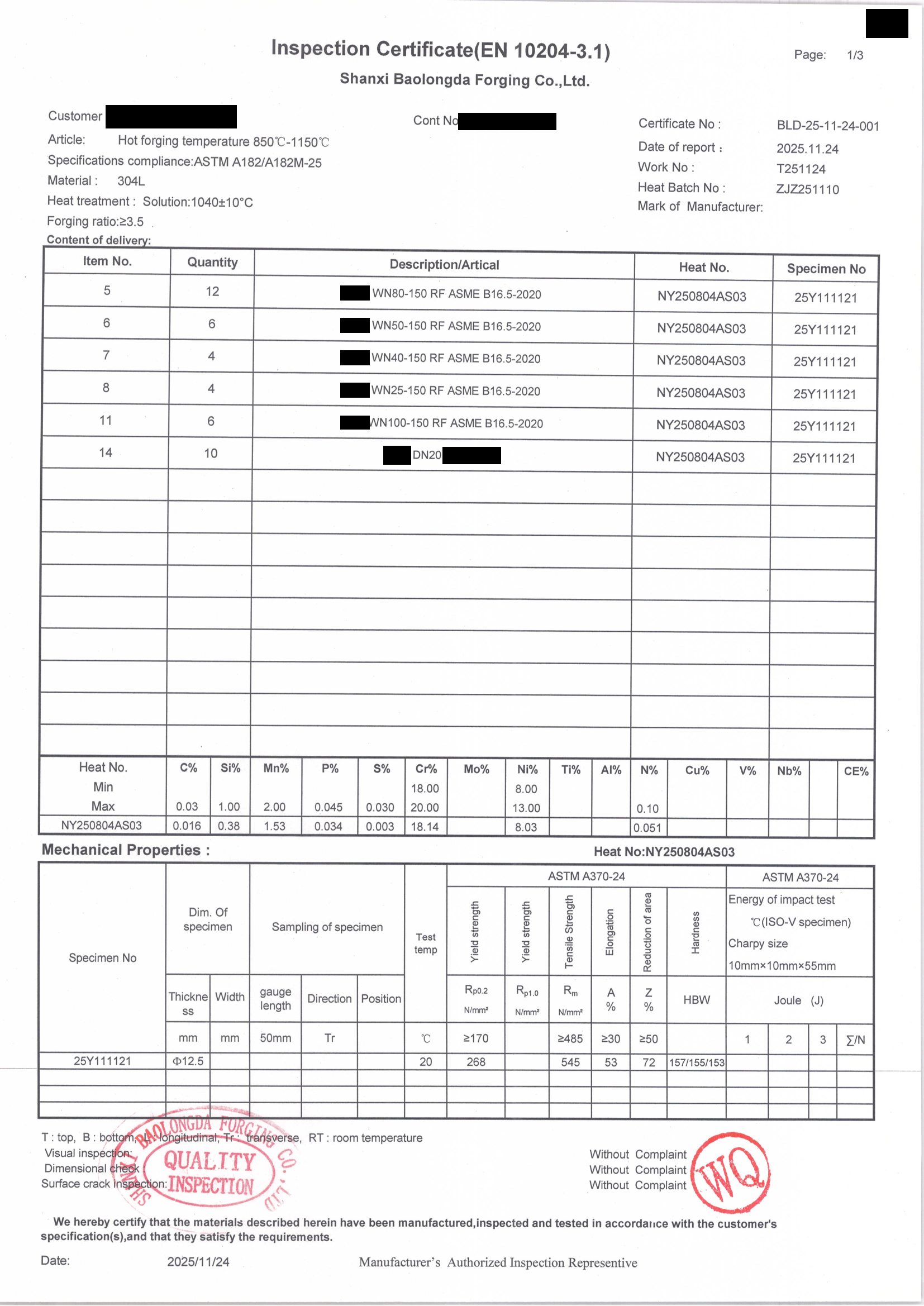
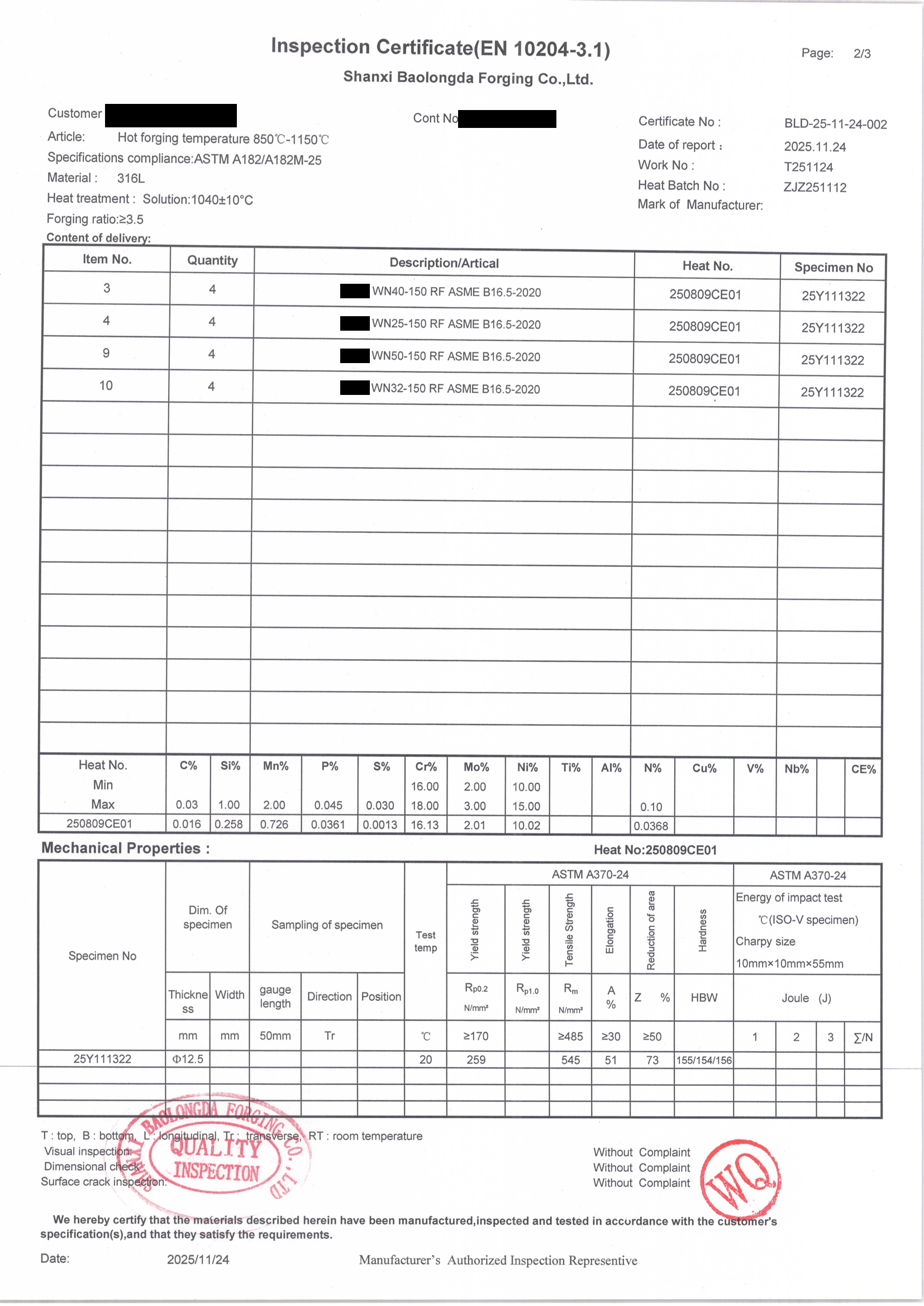
Two pages of one 3.1 inspection certificate we issued on 24 November 2025 for ASTM A182 weld neck flanges: page 1 for 304L (heat NY250804AS03), page 2 for 316L (heat 250809CE01). Each page lists the solution treatment, the heat's chemistry against the grade limits, tensile and hardness results, and the visual, dimensional and surface-crack inspection. Customer, contract and customer item codes are covered.

Evidence

  • 304L, heat NY250804AS03: C 0.016 %, Cr 18.14 %, Ni 8.03 %, N 0.051 %; Rp0.2 268 N/mm², Rm 545 N/mm², A 53 %, Z 72 %, hardness 157/155/153 HBW.
  • 316L, heat 250809CE01: C 0.016 %, Cr 16.13 %, Mo 2.01 %, Ni 10.02 %, N 0.0368 %; Rp0.2 259 N/mm², Rm 545 N/mm², A 51 %, Z 73 %, hardness 155/154/156 HBW.
  • Both pages: specification ASTM A182/A182M-25, solution treatment at 1040 ± 10 °C, forging ratio ≥ 3.5, and visual inspection, dimensional check and surface crack inspection recorded as "Without Complaint".

Applies when

The two pages are a certificate we issued for ASTM A182/A182M-25 weld neck flanges, one page per heat: 304L heat NY250804AS03 and 316L heat 250809CE01.

Limits

Two heats of two grades: the values are those of these heats, not typical or guaranteed values, and say nothing about other heats, grades or orders. The pages hold no impact, ferrite or corrosion-test value. PMI, ferrite and corrosion testing are fixed by your order.

304L page of a 3.1 certificate, customer details covered
316L page of a 3.1 certificate, customer details covered

Sources

Every value above was checked against the linked documents on 2026-10-24.

Stainless / Duplex RFQ Evidence Matrix

Use the matrix to separate the buyer's requirement from the evidence that must be agreed for the exact grade, heat and project. Availability, production volume and delivery timing are confirmed only after the complete RFQ is reviewed.

Stainless / Duplex RFQ Evidence Matrix
Project requirementEvidence to requestRFQ fields to sendCapability boundary
F304/F304L or F316/F316L flangeHeat-linked MTC 3.1 and PMI scope when requiredExact grade, standard, size, rating, facing, quantity and certificate wordingThe required grade and inspection scope are confirmed against the purchase specification before quotation
Duplex or super duplex flangeGrade-specific MTC plus PMI; ferrite or other project tests only when stated in the specificationExact ASTM or project grade, service condition, dimensions, quantity and acceptance criteriaEvidence for one duplex grade or heat does not establish another grade, heat or service suitability
Mill certificate requiredCertificate type, heat-number traceability and the separate inspection reports named by the project3.1 or 3.2 wording, standard revision, tests, language and third-party hold pointsAn MTC does not automatically include PMI, dimensional, ferrite or NDT reports
High-volume requestWritten feasibility review for the exact grade, size mix, quantity, inspection scope and requested dateLine-item quantities, target delivery date, destination, drawing or standard and document packageNo production capacity or lead-time commitment is made until the complete line list is reviewed
Sour-service or NACE wordingThe buyer's named standard, edition and project acceptance criteriaService conditions, exact grade, hardness or test limits and required document wordingMaterial family alone does not establish NACE compliance or fitness for sour service

Also known as

stainless steel flangestainless forged flangeduplex flangeA182 flange

How to Send This RFQ

Send these details

  • Standard or drawing
  • Size / DN / NPS
  • Pressure class / PN
  • Material grade
  • Facing
  • Bore
  • Quantity
  • Heat treatment
  • Inspection requirement
  • Destination country
  • Third-party inspection need

Avoid these omissions

  • Sending a product name without standard, drawing or pressure rating
  • Leaving bore, facing or bolt pattern unclear
  • Mixing DN, NPS, PN and class references without a drawing
  • Omitting inspection documents until after price discussion
  • Forgetting destination country, packing or third-party inspection requirements

Manufacturing and Inspection Route

We confirm each step against your drawing or standard before we quote.

  1. Material review

    Material grade, heat number, certificate basis and substitution limits are checked against the Stainless Steel Forged Flanges drawing or standard before procurement is released.

  2. Forging process confirmation

    The forging route is selected around flange type, section thickness, bore allowance, hub or neck geometry and pressure-service requirements.

  3. Heat treatment

    Heat treatment is planned with the required record package, mechanical testing basis and impact-test condition where low-temperature or alloy service applies.

  4. Rough machining

    Rough machining opens reference faces, bore, hub, neck or sealing-face stock needed to control allowance before final flange machining.

  5. Final machining

    Final machining controls facing, bore, bolt pattern, groove, sealing surface and flange-table or drawing tolerances before dimensional inspection is issued.

  6. Inspection and document review

    Inspection covers dimensional report, MTC 3.1, PMI and required UT, MT or PT records before the release documents are matched to the purchase order.

  7. Marking, packing and export document preparation

    Marking, packing and export documents are prepared by PO line item so the Stainless Steel Forged Flanges shipment can clear customs and be identified at site receiving.

Inspection and Documents

List document requirements in the first RFQ; they affect price and schedule.

  • MTC EN 10204 3.1
  • Heat treatment record
  • Dimensional report
  • PMI when alloy verification is required
  • UT, MT or PT when specified
  • Tensile, impact or hardness test records when required
  • Third-party inspection support by project request

FAQ

Is 12Х18Н10Т the same as A182 F321?

Not automatically. Both are titanium-stabilised 18-10 steels, but GOST 5632 allows up to 0.12 % carbon in 12Х18Н10Т against 0.08 % maximum for F321. 08Х18Н10Т is the closer mark; state which one your specification requires.

Is S22053 the same as 2205?

S22053 is the Chinese designation whose printed windows match UNS S32205, the tighter 2205 window (A182 F60). A heat inside that window also sits inside S31803 (F51), which is why F51/F60 dual certification exists - but the tests and certificate wording are still checked per grade.

Do you supply super duplex F53 and F55?

F53 and F55 are listed in the Annex I material scope of our certification to ASME Section II Part A by TÜV NORD. That is a certified scope, not a shipment record: send the exact grade, sizes and tests, and they are confirmed by review before quotation.

Is there a JIS forging grade for duplex?

No. JIS G 3214 lists austenitic and other stainless forging grades but no duplex grade; SUS329J3L is a bar and plate designation. A JIS-based order for duplex flanges therefore names an ASTM, EN or project grade.

Commercial terms

Reply time
We reply to every RFQ within 8 hours.
Service hours
08:00–20:00 Eastern Time (ET; UTC−5, UTC−4 in summer), every day, including public holidays.
Minimum order
1 piece
Samples
Free of charge; you pay the freight.
Lead time
9 to 30 days after drawing approval.
Payment
30% deposit with the order; the balance is paid in full when the goods arrive at the port in China that you designate. The same applies to FOB, CFR and CIF.
Packing
Surfaces are coated with anti-rust oil. Most orders go in wooden cases, and every wooden case is fumigated. Large parts are steel-strapped onto pallets and wrapped in waterproof tarpaulin.
Quality claims
After you report a problem, we give you a handling plan within 8 hours.
Delivery terms
Standard: FOB the Chinese port you designate, Incoterms® 2020; we usually ship from Tianjin. On request: CFR or CIF to your destination port, quoted per RFQ. Other Incoterms® 2020 terms, except EXW and DDP, are quoted on request.

Send your RFQ or drawing directly to BLD Forge Direct.

Email quote@bldforgedirect.com with standard, drawing, material, quantity and inspection requirements.

Request a quoteWhatsApp