Chrome-Moly Alloy Steel Flanges: F11, F22, F5, F9, F91 for High-Temperature Service

Chrome-moly steels add chromium and molybdenum so that a flange keeps its strength and resists oxidation at temperature - the grades for steam, boiler and refinery heater lines. Each step up from 1.25Cr-0.5Mo F11 to 9Cr-1Mo-V F91 buys temperature capability and makes the heat treatment more exacting.

Chrome-Moly Alloy Steel Flanges Explained

The grades differ in chromium content and in the heat treatment they may receive. ASTM A182 allows annealing, or normalizing and tempering, for F11, F22, F5 and F9 according to grade and class, and requires normalizing and tempering for F91; the certificate states which treatment your flanges received and at what temperatures. F91 is the demanding one: its strength at temperature depends on a correct normalize-and-temper cycle, which is why buyers put a hardness window on it and read it on every heat.

Post-weld heat treatment matters as much as the delivery condition. A welded chrome-moly line is stress-relieved after welding, and if your code needs test pieces that have seen a simulated post-weld cycle, the cycle belongs on the order so the pieces are cut, treated and tested before shipment. Send the design temperature, the grade class or type, any hardness limit and the certificate type with the first RFQ.

Engineering Snapshot

Product family, supply scope and the next two steps, in one place.

Product family: Flanges

Chrome-Moly Alloy Steel Flanges Supply Scope

Chrome-moly flange RFQs are checked for the exact A182 grade and class or type, the governing standard and rating, the heat-treatment condition, any hardness limit, simulated PWHT test pieces and the certificate type before quotation.

  • ASTM A182 F11, F22, F5, F9 and F91, with F1 and F12 on request
  • Nearest EN 10222-2, JIS, NB/T 47008 and GOST designations in one table
  • Heat treatment, PWHT test pieces and hardness stated on the certificate
Chrome-moly grades across standards (nearest designations)

Every cell is the nearest designation for RFQ orientation, not an equivalence: the purchase specification governs, and putting one designation in place of another needs the purchaser's written approval. Each row carries an anchor, so a line in your enquiry can point at it.

Chrome-moly forging grades: ASTM A182, EN 10222-2, JIS G 3203, NB/T 47008, GOST and DNV grades
Common nameUS: ASTM A182EU: EN 10222-2JIS G 3203China: NB/T 47008GOSTDNV gradeDifferences to state
C-0.5MoF116Mo3 (1.5415)——NV F0.5Mo16Mo3 (EN 10222-2) is also named in our AD 2000-Merkblatt W 0 scope
1Cr-0.5MoF1213CrMo4-5 (1.7335)15CrMoNV F1Cr0.5Mo13CrMo4-5 is the nearest EN forging grade to F12, not to F11
1.25Cr-0.5Mo-SiF11 Class 1, 2, 313CrMo4-5 only by review14Cr1Mo——No exact EN 10222-2 counterpart; state the class - Classes 1, 2 and 3 differ in strength
2.25Cr-1MoF22 Class 1, 311CrMo9-10 (1.7383)SFVAF22A
SFVAF22B
12Cr2Mo1NV F2.25Cr1Mo11CrMo9-10 is the EN forging name; 10CrMo9-10 (1.7380) is the plate and tube name
5Cr-0.5MoF5X16CrMo5-1 (1.7366)1Cr5Mo15Х5М—Above the alloy grades printed on our DNV approval
9Cr-1MoF9—Above the alloy grades printed on our DNV approval
9Cr-1Mo-V-NbF91 Type 1, 2X10CrMoVNb9-1 (1.4903)10Cr9Mo1VNbN—Our F91 type test measured hardness, tensile and chemistry - no impact test
Cr-Mo-V (GOST)——12Х1МФ—No ASTM A182 counterpart; a GOST-only row

A dash means no designation was found in that system; a blank cell means we have not yet checked that system's current edition, so we list nothing there rather than guess. The DNV grades are the ones printed on our DNV approval AMMM0000388 for alloy forgings.

Heat treatment and PWHT: what the certificate has to show

With chrome-moly the heat-treatment line on the certificate is part of the material identity, not a formality. These are the items we put on the certificate or the test record when the order asks for them.

  • Delivery condition by grade: annealed, or normalized and tempered, for F11, F22, F5 and F9 as the grade and class allow; normalized and tempered for F91 - with the normalizing and tempering temperatures stated.
  • Hardness readings per test piece against the window your specification sets, and where on the flange they were taken.
  • Simulated PWHT test pieces: cut from the same heat, treated with the cycle your welding procedure uses, tested before shipment - the cycle has to be on the order.
  • Tensile at room temperature as standard; elevated-temperature tensile or creep data only when the order names them.
  • PMI on chromium and molybdenum when your specification calls for it, reported separately from the MTC.

What sits inside our certified scope - and what does not

The chrome-moly grades on this page are within the scope of our materials certification to ASME Section II Part A by TÜV NORD (Annex I lists SA-182 F11, F22, F5, F9, F91 and also F1 and F12, with one size cell of 550 mm thickness and 7,000 kg). That certificate assesses material conformity on samples; it is not an assessment of each order and carries no Code stamp.

For classed marine work, our DNV approval AMMM0000388 prints three alloy grades - NV F0.5Mo, NV F1Cr0.5Mo and NV F2.25Cr1Mo - for open-die forgings up to 1,000 kg and 200 mm, normalized, normalized and tempered or quenched and tempered. F5, F9 and F91 are not on that list.

We publish no order certificate for F11, F22, F5 or F9 on this page. The measured evidence below is one F91 type test, and its values belong to F91 only.

Chrome-Moly Alloy Steel Flanges Technical Specification

The single authoritative view of what we can supply against your standard, drawing, material and inspection requirements.

Scope and rating
Grade scopeASTM A182 F11 (Class 1, 2, 3), F22 (Class 1, 3), F5, F9 and F91 (Type 1, 2); F1 and F12 on request.
Standards and materials
Standards / drawings
  • ASME B16.5 and B16.47 by class
  • EN 1092-1 by PN
  • JIS B 2220 by K rating
  • GOST 33259 by PN
  • Project drawing for hot-service nozzles and special flanges
Material grades
  • ASTM A182 F11 (Class 1, 2 or 3)
  • ASTM A182 F22 (Class 1 or 3)
  • ASTM A182 F5
  • ASTM A182 F9
  • ASTM A182 F91 (Type 1 or 2)
  • ASTM A182 F1 and F12 on request
Geometry, tolerance and inspection
Heat-treatment conditionAnnealed, or normalized and tempered, for F11, F22, F5 and F9 as grade and class allow; normalized and tempered for F91 - temperatures stated on the certificate.
Critical dimensionsFlange type, facing, bore at the weld end, hub dimensions and bolt pattern from the governing standard or drawing.
Inspection depthHardness per test piece, tensile, simulated PWHT test pieces when ordered, PMI on Cr and Mo when specified, UT/MT/PT as named, EN 10204 3.1 or 3.2.
Reviewed before quotation
  • Grade with class or type, and design temperature
  • Heat-treatment condition and temperatures on the certificate
  • Hardness limit and where it is measured
  • Simulated PWHT cycle for test pieces, if required
  • Certificate type 3.1 or 3.2 and any third-party inspection
Buying logic
Best-fit RFQBest for flange line items in steam, boiler, refinery heater and other high-temperature service where ASTM A182 F11, F22, F5, F9 or F91 is specified.
Buyer applicationPower plant steam lines, refinery heaters and hydroprocessing units, boiler headers and high-temperature process piping.
Download this table as PDF Send Product RFQ

Generated from the published values above - it does not invent standard dimensions. Final manufacturing and inspection follow your current standard, drawing revision and project specification.

F91: What an Outside Body Measured

The answer comes first, then the evidence, where it applies and where it stops. Each value is read from the document it links to.

What has an outside body measured on an F91 flange we forged?

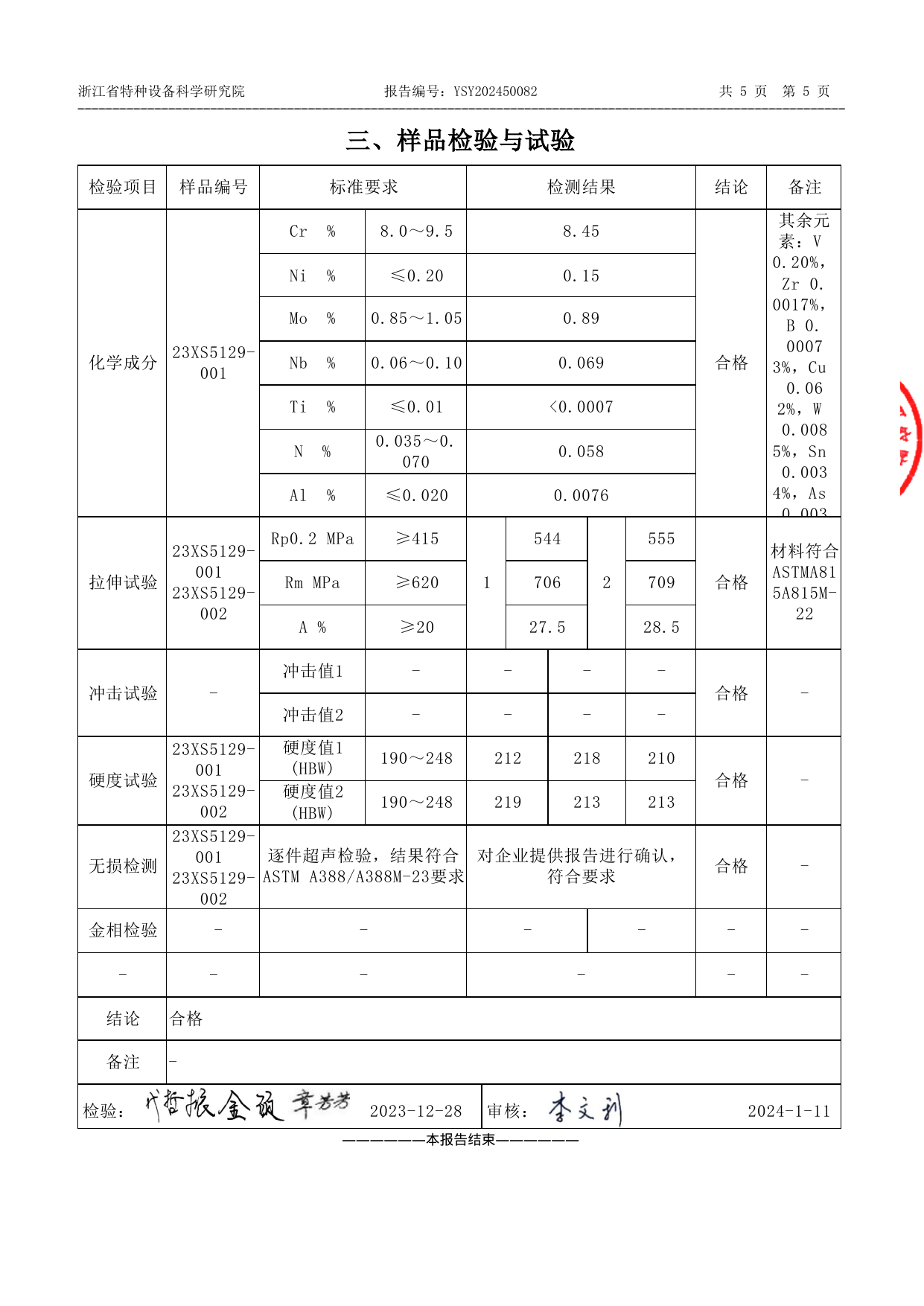
On one type-test sample set in F91, report YSY202450082 records six Brinell hardness readings - 212, 218 and 210 HBW on one specimen and 219, 213 and 213 HBW on the other, 210 to 219 HBW in all - against the 190-248 HBW window printed beside them, with tensile and chemistry inside their printed limits. F91 was not impact-tested: the impact row of the report is empty.

Evidence

  • Report YSY202450082, section III, report page 5 of 5, hardness row: specimen 23XS5129-001 reads 212, 218 and 210 HBW; specimen 23XS5129-002 reads 219, 213 and 213 HBW; the requirement column reads 190-248 HBW on both lines
  • Same page, tensile row: Rp0.2 544 and 555 MPa against a 415 MPa minimum, Rm 706 and 709 MPa against 620 MPa, elongation A 27.5% and 28.5% against 20%
  • Same page, chemistry on specimen 23XS5129-001: Cr 8.45 (8.0-9.5), Mo 0.89 (0.85-1.05), Nb 0.069 (0.06-0.10), N 0.058 (0.035-0.070), Ni 0.15 (max 0.20), Al 0.0076 (max 0.020) percent
  • Same page, impact row: dashes in every value cell - no impact test was run on this sample
  • Issued by the Zhejiang Academy of Special Equipment Science; testing signed 2023-12-28, review signed 2024-01-11

Applies when

The sample was an NPS 4 Class 150 raised-face weld neck flange in F91 from our own production, tested as part of a special-equipment type test; two pieces were tested, three hardness readings on each.

Limits

These values belong to F91 and to these two samples only: they are not typical, minimum or guaranteed values, and they say nothing about F11, F22, F5 or F9. The report holds no impact value and no elevated-temperature or creep test. An order that needs impact values or high-temperature properties states them and receives its own certificate.

Page 5 of 5 of type-test report YSY202450082: chemistry for chromium, nickel, molybdenum, niobium, titanium, nitrogen and aluminium, tensile results for two specimens, an impact row filled with dashes, and six Brinell hardness readings between 210 and 219 HBW for our F91 weld neck flange
Report YSY202450082, page 5 of 5: the F91 data page

Sources

Every value above was checked against the linked documents on 2026-09-26.

Also known as

chrome moly flangeCr-Mo flangeA182 F22 flangeF91 flange

Manufacturing and Inspection Route

Use this route to understand what has to be confirmed before price, lead time, MTC 3.1 and third-party inspection commitments are made.

  1. Material review

    Material grade, heat number, certificate basis and substitution limits are checked against the Chrome-Moly Alloy Steel Flanges drawing or standard before procurement is released.

  2. Forging process confirmation

    The forging route is selected around flange type, section thickness, bore allowance, hub or neck geometry and pressure-service requirements.

  3. Heat treatment

    Heat treatment is planned with the required record package, mechanical testing basis and impact-test condition where low-temperature or alloy service applies.

  4. Rough machining

    Rough machining opens reference faces, bore, hub, neck or sealing-face stock needed to control allowance before final flange machining.

  5. Final machining

    Final machining controls facing, bore, bolt pattern, groove, sealing surface and flange-table or drawing tolerances before dimensional inspection is issued.

  6. Inspection and document review

    Inspection covers dimensional report, MTC 3.1, PMI and required UT, MT or PT records before the release documents are matched to the purchase order.

  7. Marking, packing and export document preparation

    Marking, packing and export documents are prepared by PO line item so the Chrome-Moly Alloy Steel Flanges shipment can clear customs and be identified at site receiving.

Inspection and Documents

Include document requirements with the first RFQ so inspection cost and timing are visible before offer comparison.

  • MTC EN 10204 3.1 (3.2 when the order names an inspection body)
  • Heat-treatment record with temperatures
  • Hardness readings per test piece
  • Tensile test; high-temperature tensile only when ordered
  • PMI to confirm chromium and molybdenum when specified
  • UT, MT or PT as the order names them
  • Dimensional report

How to Send This RFQ

Complete offers come back fastest when the first message carries the data below - and avoids the omissions that make quotations look cheaper than they are.

Send these details

  • Grade and class or type, e.g. A182 F22 Class 3 or F91 Type 1
  • Governing standard and rating, e.g. ASME B16.5 Class 900
  • Flange type, size, facing and bore
  • Design temperature
  • Heat-treatment condition required
  • Hardness limit and location
  • Simulated PWHT cycle for test pieces
  • NDT methods and acceptance standard
  • Certificate type and inspection body
  • Quantity and destination

Avoid these omissions

  • Writing 'Cr-Mo' or 'alloy steel' without the A182 grade and class
  • Treating 13CrMo4-5 as the same steel as F11
  • Leaving the PWHT cycle for test pieces off the order
  • Asking for impact values on F91 after the certificate is issued
  • Assuming a hardness window without stating it on the RFQ

FAQ

Short answers for common RFQ questions.

Is 13CrMo4-5 the same as A182 F11?

No. 13CrMo4-5 is the nearest EN 10222-2 forging grade to F12 (1Cr-0.5Mo). F11 (1.25Cr-0.5Mo with silicon) has no exact EN 10222-2 counterpart, so offering 13CrMo4-5 against an F11 line needs the purchaser's written approval.

What is the EN forging name for F22?

11CrMo9-10 (1.7383) in EN 10222-2. 10CrMo9-10 (1.7380) is the name used for plate and tube, not for forgings.

Was your F91 flange impact-tested?

No. Our F91 type test reports chemistry, tensile and six Brinell hardness readings; its impact row is empty. If your order needs impact values on F91, state the test temperature and energy on the RFQ and they are reported on that order's own certificate.

Can you supply F91 flanges for marine or classed projects?

F91 is listed in Annex I of our materials certification to ASME Section II Part A by TÜV NORD, but it is not among the alloy grades printed on our DNV approval, which stop at 2.25Cr-1Mo. For a classed project, name the society and rules on the RFQ so the survey route can be confirmed first.

Send your RFQ or drawing directly to BLD Forge Direct.

Email quote@bldforgedirect.com with standard, drawing, material, quantity and inspection requirements.